How to Minimize Concrete Cracks
Concrete Cracking Happens — We Use Proven Knowledge and Skills to Minimize
So your home enhancement project looks really good for many years to come
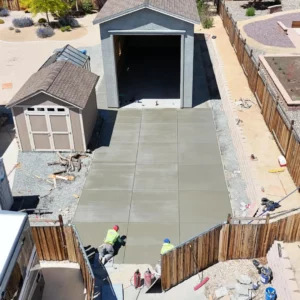
New garage/workshop gets a new driveway
At Reno Tahoe Concrete, we get many questions about concrete cracking. Why does concrete crack? Should I make my slab thicker? How can I prevent my new concrete from cracking?
Monolithic slabs, sidewalks, driveways, retaining walls, and other Poured-In-Place, Ready Mix concrete projects can crack. We aim to minimize cracking by following best practices.
Concrete is a very dense material.
Concrete is a mixture of Portland cement, aggregates (rocks and sand), and water. The ratios of each must carefully maintained to get the best end results.
We order the concrete from a Ready-Mix concrete batch plant. The process of mixing the main ingredients is precisely controlled. Too much water is to be avoided.
Not Too Much Water Now
If the concrete is too wet, there will be more evaporation and shrinkage. Controlling the amount of water in the mix helps to keep shrinkage to a minimum.
If the curing concrete shrinks too much through evaporation, we will get more cracks. Concrete curing is mostly a chemical reaction process. Most of the water is used in this chemical process. Excess water must evaporate and that is material loss … or shrinkage.
We want to minimize and avoid shrinkage.
(For more information about how concrete cures, stay tuned to our future article.)
We order your Ready-Mix Concrete as “stiff” a mixture as possible. Stiff in this case means that less water is used thereby making for a thicker concrete batter. It also means that it requires more manpower to handle the “dryer” wet concrete.
Control Joints to Minimize Cracking
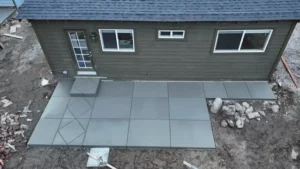
Decorative Control Joints minimize cracks
The second action we take on all our projects is to use Control Joints. They are cut into the wet concrete during our finishing process.
Control Joints are the slightly rounded indentations that you see every 4-feet in a city sidewalk.
They act as a pathway for stresses and therefore cracks to follow. We recommend a pattern of 10’ x 10’ grid control joints on all driveway pours. Sidewalks are every 4’ of length.
We can even add some decorative touches during this part of the project. Talk to Jose when he is out at your site looking over your hardscape project goals.
Preparing your site is important
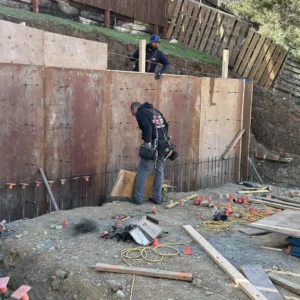
Will be a 10ft tall concrete retaining wall
To prevent cracks through earth settlement … where the ground underneath settles … requires us to invest in proper site preparation.
We will survey and layout your project area. Then we excavate/remove earth from the project area to an adequate depth.
We need to remove enough existing earth allowance for the finish concrete thickness as well as a 4” layer of compacted base rock material.
Compaction of the underlying base materials is critical for mitigating future settlement and resulting cracking.
For heavy equipment, we can increase the depth of the compacted base rock. But for most home projects, 4” of compacted base is adequate.
Slab Thickness
Driveways are usually 4” thickness (nominal) which is good for cars and light pickup trucks. If there will be heavier equipment, we will discuss making the slab thicker.
Too Much Clay is not our friend
When we are excavating for your project, if we come across a pocket of unstable clay, we then may have to remove more earth. This will mean the need for additional compacted base rock material.
Why? If we do not remove this material and create a deeper base rock, when the clay gets wet, it can sink. This can lead to concrete cracking and failure if sever enough.
We will not let this happen to your project on our watch.
Our friend – REBAR … steel reinforcement
Weight from heavy equipment traffic for most home projects is usually not an issue. But we add rebar on certain projects to increase the strength of the concrete project.
Rebar is a strengthen addition to the concrete pour. It helps two-fold …
First, it resists movement of the concrete mass. If stains pull in different directions, cracking will happen. Rebar helps prevent this movement.
Second, it resists vertical movement from minor settling.
Benefits of Air-Entrainment
In cold climates, the incorporation of air into the wet mix helps by providing space for ice to expand. Concrete might appear be solid but structure contains pours. So if water freezes and thaws, the water expands and contracts. The air pockets help to minimize cracking from expansion during the freeze/thaw cycles in cold winter areas.
In our next post, we talk about concrete pavers for home paving projects.